

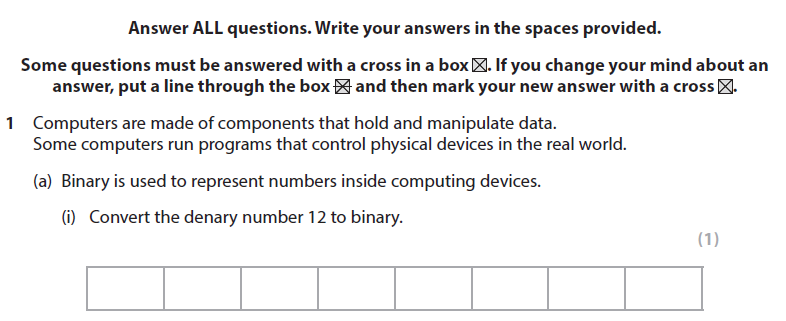
1Ai Answer
0000 1100
More help here -
More help here -

1aii answer
5
More help here -
More help here -
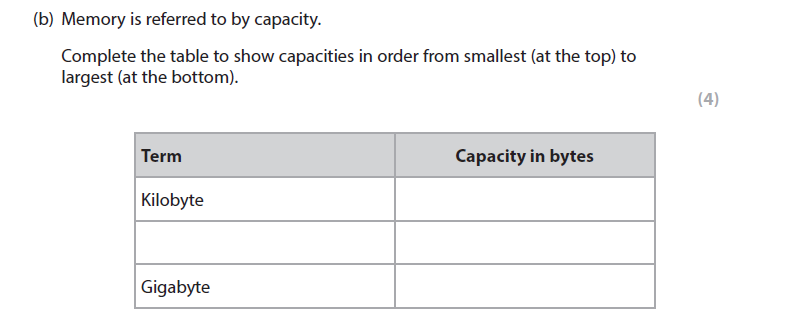
1b answer

More help here -
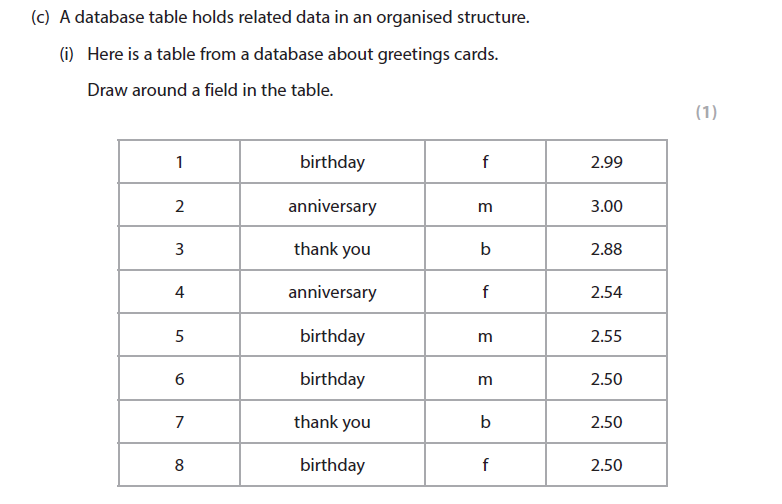
1ci answer
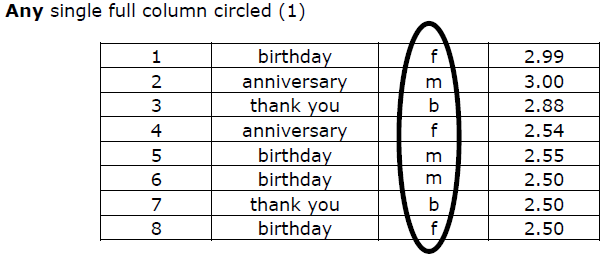
More help here -
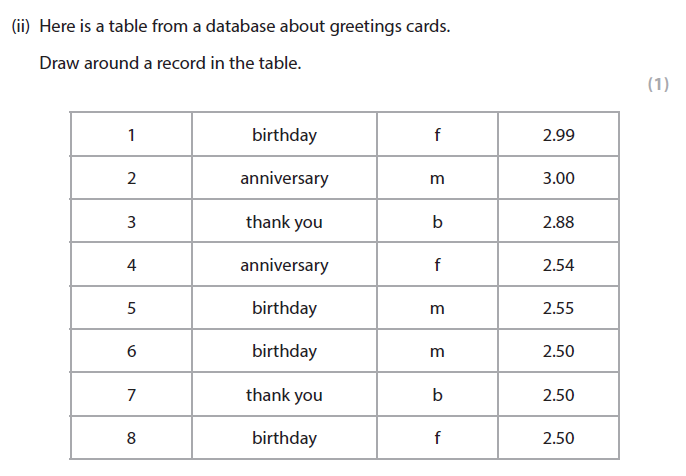
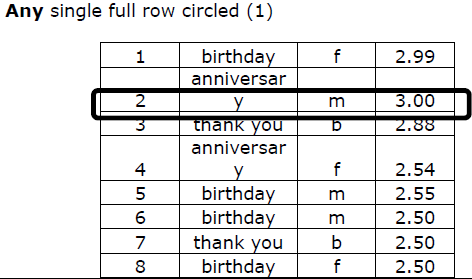
1cii answer
More help here -
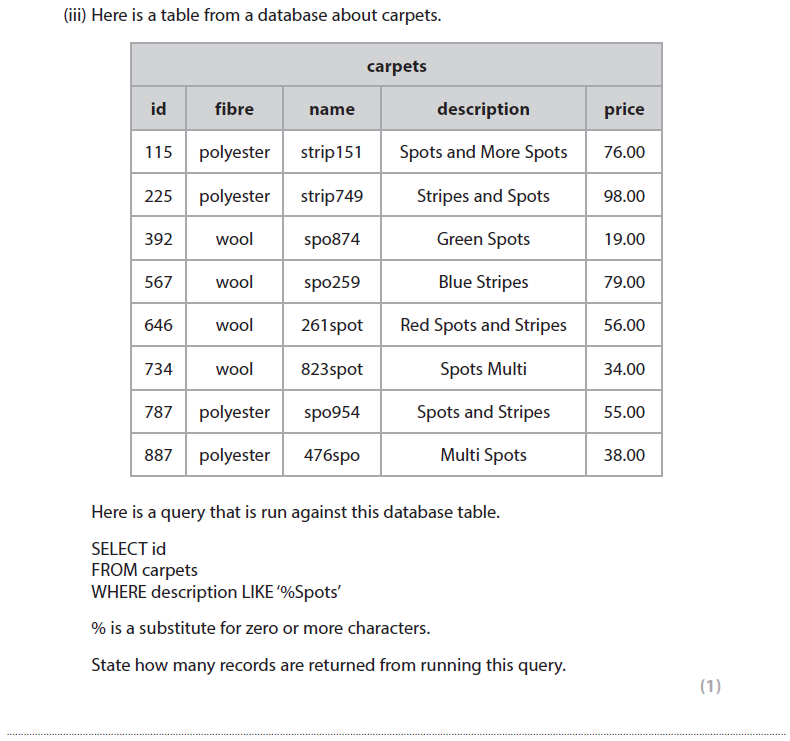
1ciii answer
4
More help here -
More help here -
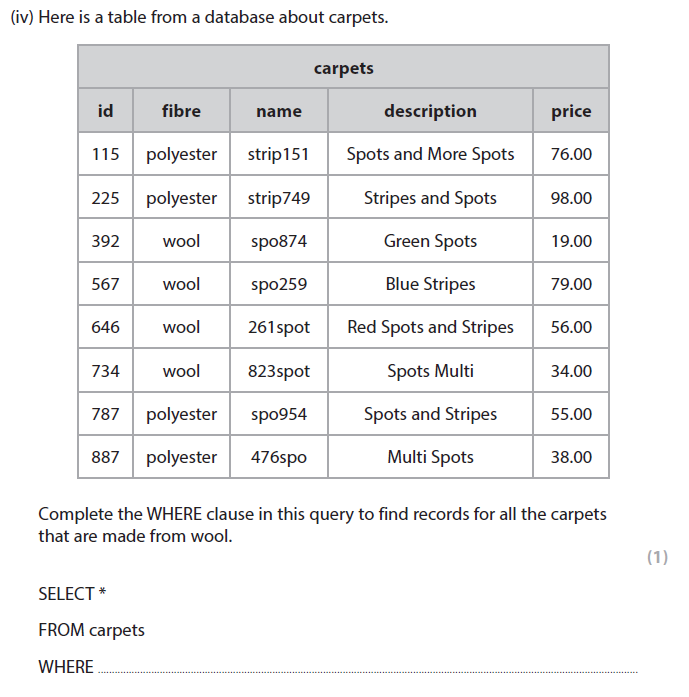
1civ answer
fibre='wool'
Allow ‘IS’ for ‘=’
Allow ‘==’ for ‘=’
More help here -
Allow ‘IS’ for ‘=’
Allow ‘==’ for ‘=’
More help here -
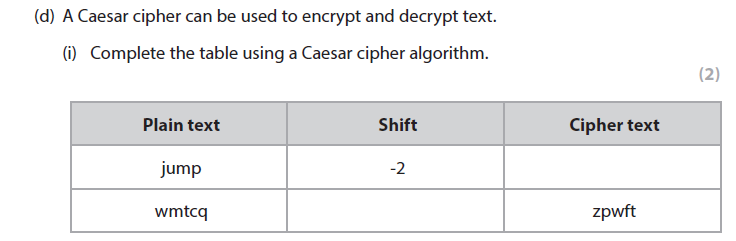
1di answer
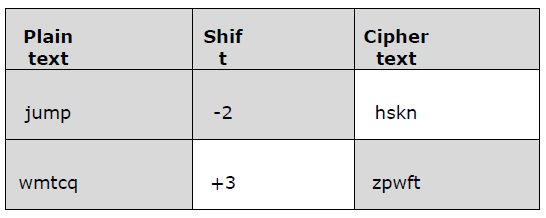
More help here -
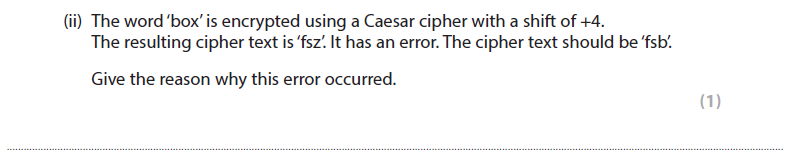
1dii answer
(When reaching the end of the alphabet), the algorithm does not go back to the beginning of the alphabet
More help here -
More help here -
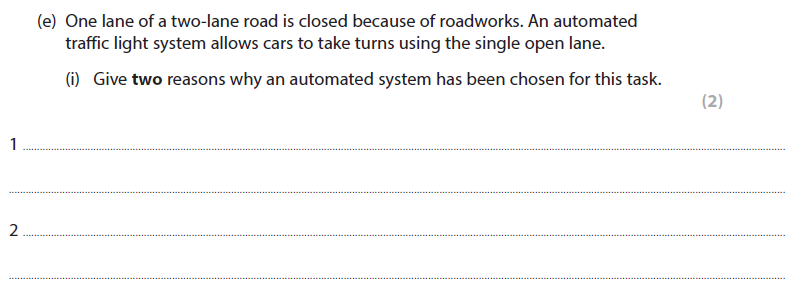
1ei answer
Any two of:
An automated system can run 24/7 (1)
An automated system n automated system does not need to be paiddoes not need to be paid (1)
Shouldn’t make mistakes / more reliable / safer (1)
Cheaper than employing people (1)
Leaves road workers free to do other tasks (1)
More help here -
An automated system can run 24/7 (1)
An automated system n automated system does not need to be paiddoes not need to be paid (1)
Shouldn’t make mistakes / more reliable / safer (1)
Cheaper than employing people (1)
Leaves road workers free to do other tasks (1)
More help here -
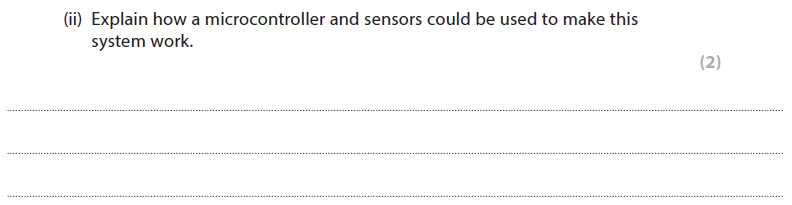
1eii answer
Naming a suitable sensing device for this situation (1) (including pressure, light, ultrasonic, distance, motion)
Concept of detection / input (1)
Concept of the microprocessor having a process / program (1)
Microprocessor generating an output / signal change (1)
More help here -
Concept of detection / input (1)
Concept of the microprocessor having a process / program (1)
Microprocessor generating an output / signal change (1)
More help here -
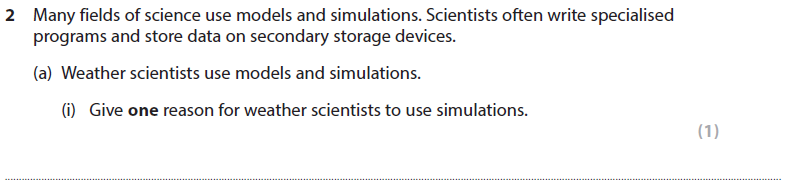
2ai answer
Any one of:
Predict weather patterns/storms/hurricanes/etc.
Investigate scientific hypotheses/climate change/etc.(1)
Run experiments because they can’t change the weather for real (1)
More help here -
Predict weather patterns/storms/hurricanes/etc.
Investigate scientific hypotheses/climate change/etc.(1)
Run experiments because they can’t change the weather for real (1)
More help here -

2aii answer
Any one of:
rainfall amounts
hours of sunshine
wind direction/speed
temperatures
humidity
at mospheric pressure (air density)
elevation (above sea level)
More help here -
rainfall amounts
hours of sunshine
wind direction/speed
temperatures
humidity
at mospheric pressure (air density)
elevation (above sea level)
More help here -

2aiii answer
Any two of:
Very large amounts of data are collected (1)
Algorithms are mathematically complex/intensive (1)
Algorithms may need Algorithms may need more more CPU cycles as the amount of data grows (1)
To be of value, the results must calculated as quickly possible (1)
More help here -
Very large amounts of data are collected (1)
Algorithms are mathematically complex/intensive (1)
Algorithms may need Algorithms may need more more CPU cycles as the amount of data grows (1)
To be of value, the results must calculated as quickly possible (1)
More help here -
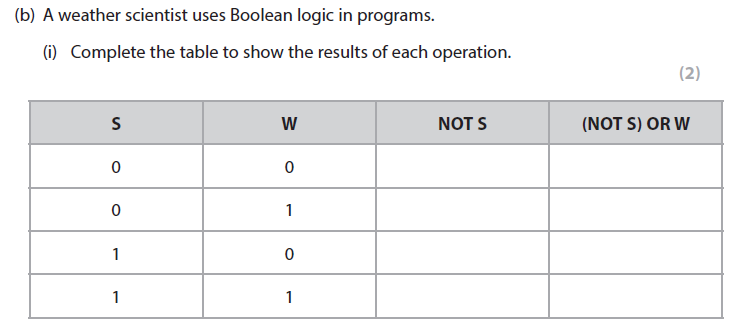
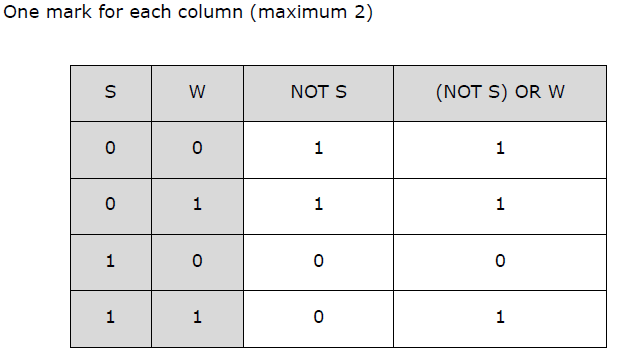
2bi answer
More help here -

2bii answer
Q = R AND L AND W
More help here -
More help here -
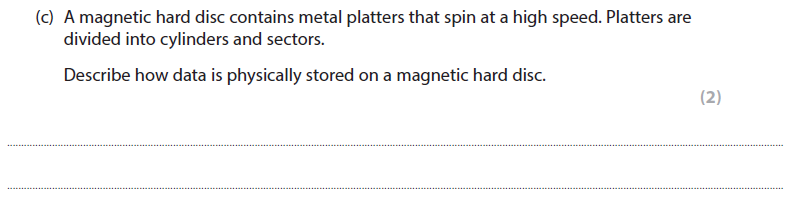
2c answer
Any 2 of:
Chemical on surface of the disc (1)
The magnetic state (of the chemical) represents data (1)
The heads move in and out (1)
Heads change/detect the (magnetic) state (1)
More help here -
Chemical on surface of the disc (1)
The magnetic state (of the chemical) represents data (1)
The heads move in and out (1)
Heads change/detect the (magnetic) state (1)
More help here -

2di answer
Any 2 of:
Indentation (1)
Meaningful/sensible variable names
Comments (1)
White space/spaces between sections of code (1)
More help here -
Indentation (1)
Meaningful/sensible variable names
Comments (1)
White space/spaces between sections of code (1)
More help here -

2dii answer
Either 16 or 17 (1)
More help here -
More help here -

2diii answer
Either 20 - 24 or 20 only (1)
More help here -
More help here -

2e answer
Any 2 of:
Code is easier to read (1)
Code only needs to be written once / reduces the need to copy/paste code multiple times / shortens the code (1)
Code only needs to be debugged once / easier to find errors (1)
Reduces the size of the executable file (1)
More help here -
Code is easier to read (1)
Code only needs to be written once / reduces the need to copy/paste code multiple times / shortens the code (1)
Code only needs to be debugged once / easier to find errors (1)
Reduces the size of the executable file (1)
More help here -
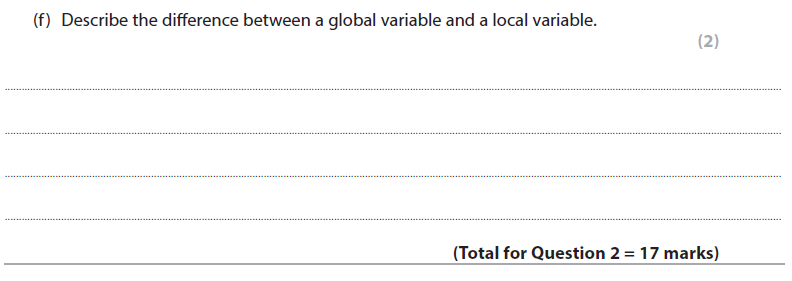
2f answer
- A global variable can be accessed from anywhere in the whole program (1), local variable can only be accessed from the subprogram/block of code in the which it is declared (1)
- Globals are persistent while program is running (1), locals are created/destroyed with each call of the subprogram (1)
- Globals can only have one instance (1), locals can have instance for each (running) subprogram (1)
More help here -
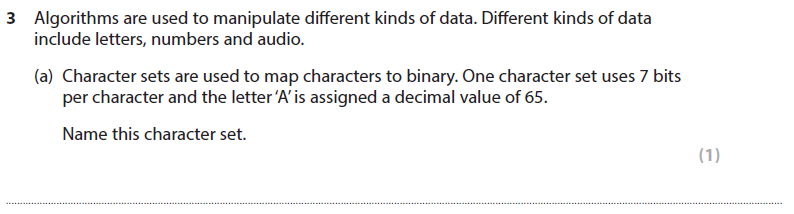
3a answer
ASCII ASCII ASCII / American Standard Code for Information Interchange
UTF-8 (1)
More help here -
UTF-8 (1)
More help here -
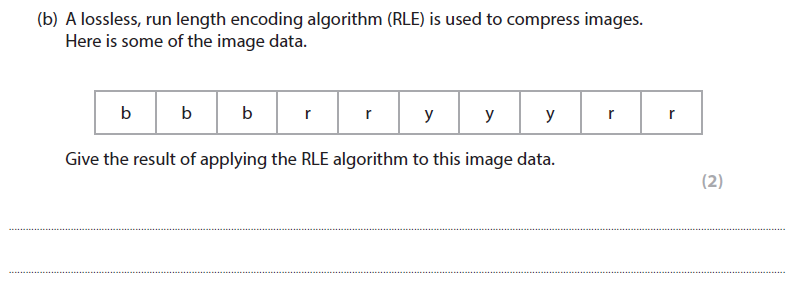
3B answer
b3r2y3r2
3b2r3y2r
One incorrect character or digit is maximum 1 mark
More help here -
3b2r3y2r
One incorrect character or digit is maximum 1 mark
More help here -
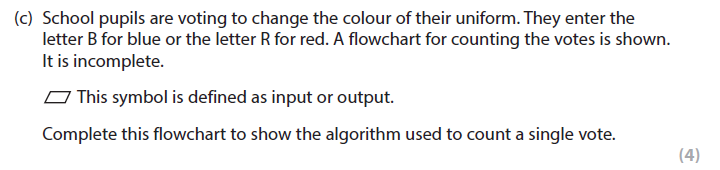
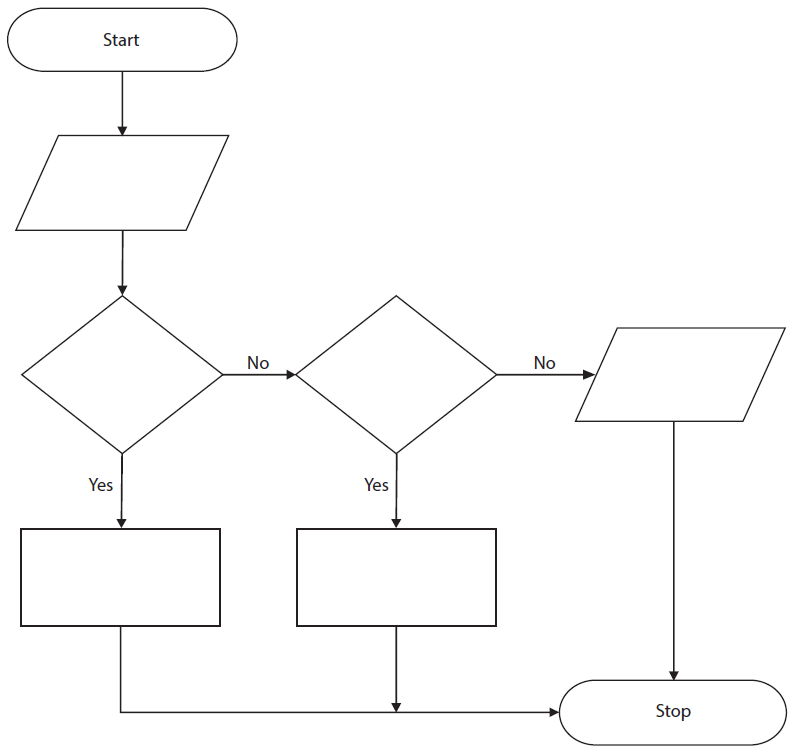
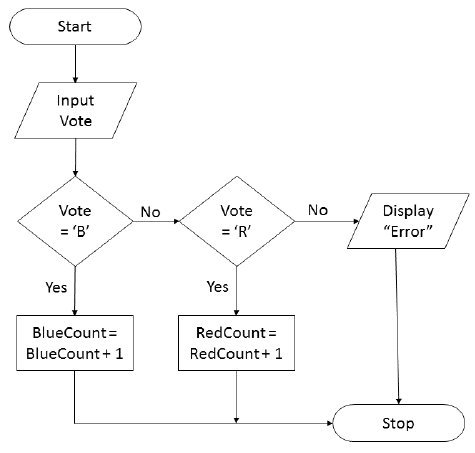
3c answer
Input value taken in trapezoid box (1)
Two decision boxes, one for red and one for blue; contents must be answerable by yes/no (1)
Two process boxes, which follow the decision box and have an indication of an increment to the vote count (1)
An indication of some type of error output, like printing or file (1)
More help here -
Two decision boxes, one for red and one for blue; contents must be answerable by yes/no (1)
Two process boxes, which follow the decision box and have an indication of an increment to the vote count (1)
An indication of some type of error output, like printing or file (1)
More help here -

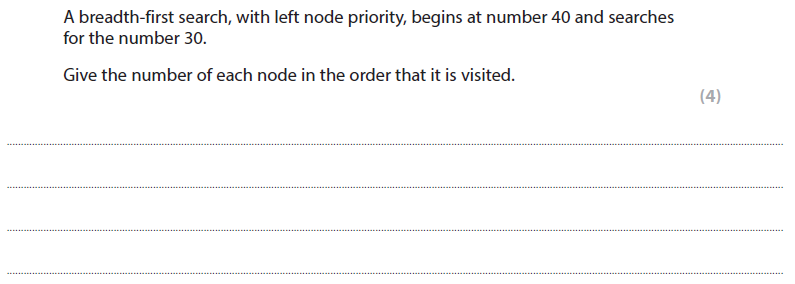
3d answer
Four or five numbers from the nodes (1)
(40, 20) or (20) as first item (1)
(45, 10) in the correct sequence (1)
30 as last number (1)
More help here -
(40, 20) or (20) as first item (1)
(45, 10) in the correct sequence (1)
30 as last number (1)
More help here -

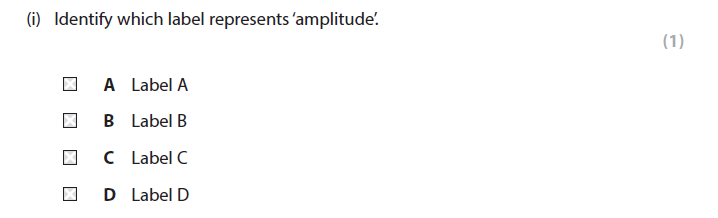
3ei answer
D (Label D)
More help here -
More help here -

3eii answer
any value in the range of 13.7 to 14.0
More help here -
More help here -

3eiii answer
Analogue signals are all continuously variable / change all the time (1)
Digital signals have only two states (0 or 1, high or low, on or off) (1) Digital signals represent analogue signals by sampling (1)
More help here -
Digital signals have only two states (0 or 1, high or low, on or off) (1) Digital signals represent analogue signals by sampling (1)
More help here -
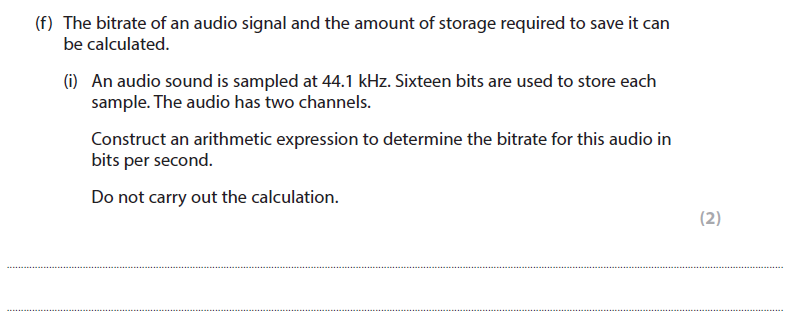
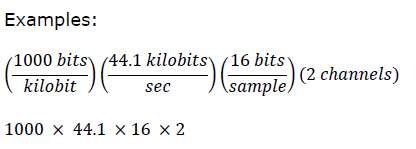
3fi answer
- One mark for multiplying by 1000
- One mark for multiplying 44.1 x 16 x 2
More help here -
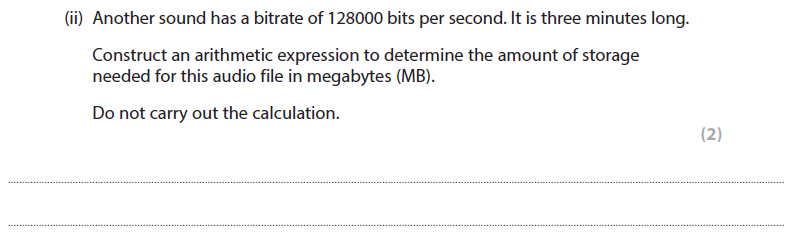
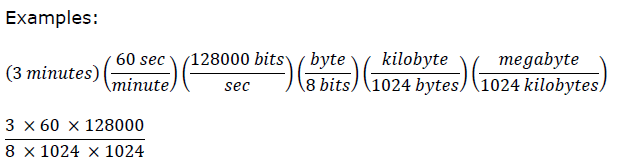
3fii answer
- One mark for (3 x 60 x128000)
- One mark for dividing by (8 x 1024 x 1024)
More help here -
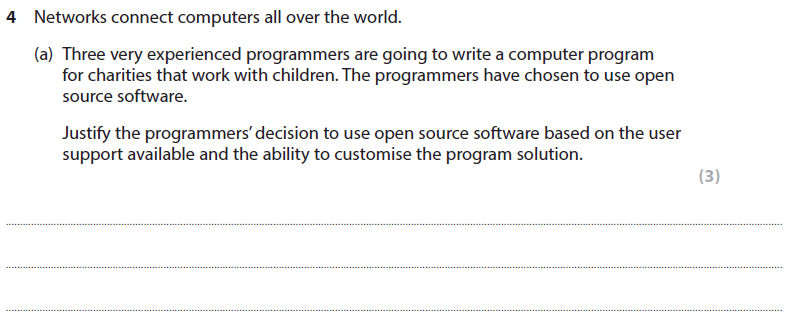
4a answer
User support available:
Ability to customise the program solution
More help here -
- Open source software is supported usually by a group of volunteers on on-line forums (1)
- Experienced programmers like these probably don’t need much support (1)
Ability to customise the program solution
- Open source code is available to be changed in any way to suit the charities (1)
More help here -

4bi answer
Any 1 of:
- Describes/defines the layout/formatting of (the content of) a web/HTML page (1)

4bii answer
B ({ font-weight:bold; text-align:center; })
More help here -
More help here -
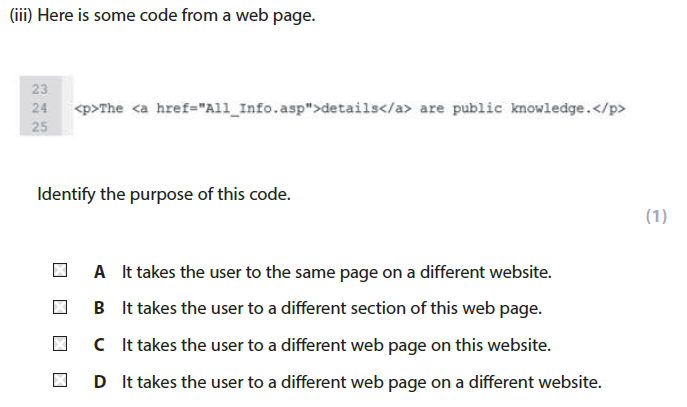
4biii answer
C (It takes the user to a different web page on this website. )
More help here -
More help here -
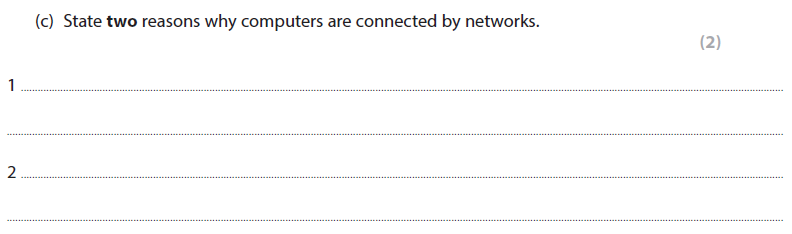
4c answer
Any two of:
More help here -
- To share data (documents, pictures, files, chat, etc.)
- To share hardware/peripherals (printers, scanners)
- To share an Internet connection (including services WWW, email, FTP, etc.)
- To distribute data or workload across different computers
- To centralise support and maintenance of software
- To allow remote access to machines
- To allow collaboration / working together
More help here -

4d answer
- Wireless (Wi-Fi, Li-Fi, IR, IrDA, microwave, Bluetooth)
- Copper cable (accept copper alone)
- Fibre optic cable (accept fibre alone)
More help here -

4e answer
One mark for a description:
AND one mark for any of:
More help here -
- A cookie is a piece of text or a small file (stored on a user’s hard disc by a web server) (1)
- A cookie records/tracks/monitors data/activities (1)
AND one mark for any of:
- Which can be retrieved on a following visit to the web site (1)
- Which uniquely identifies the visitor to the web site (1)
More help here -

4f answer
• A checksum number is calculated at the sending end (1) (based on the content of the data)
• A checksum is appended to the packet (1)
• The checksum is recalculated at the receiving end (1)
• If the new checksum and the one in the packet do not match (1), there is an error
More help here -
• A checksum is appended to the packet (1)
• The checksum is recalculated at the receiving end (1)
• If the new checksum and the one in the packet do not match (1), there is an error
More help here -
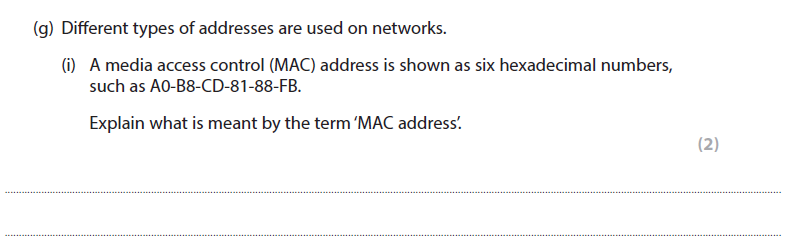
4gi answer
• A MAC address is a unique identifier for a device (1), assigned by the manufacturer (when the device is made) (1), and cannot be changed (1).
More help here -
More help here -

4gii answer
• Domain name system / Domain name server / DNS
More help here -
More help here -
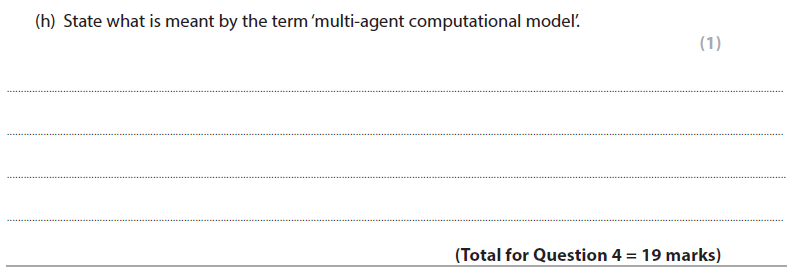
4h answer
• Computer systems/processes/devices cooperate with other computer systems/processes/devices to achieve goals.
• Systems/processes/devices cooperate without a master/ in a decentralised way
More help here -
• Systems/processes/devices cooperate without a master/ in a decentralised way
More help here -
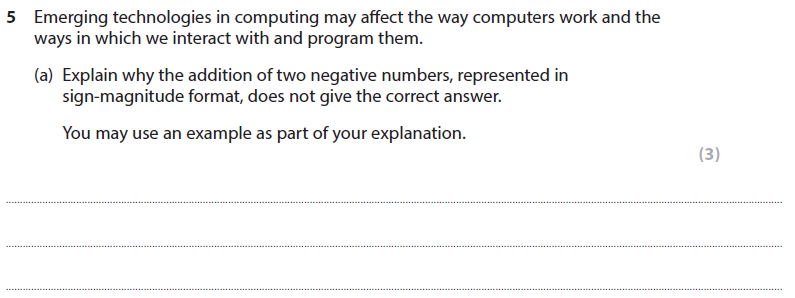
5a answer
• Negative numbers (in sign-magnitude) have a 1 in the most significant or sign bit (1)
• (In binary) 1 + 1 gives a 0 in the most significant bit (1)
• A 0 in the most significant bit would change the result from negative to positive (1)
More help here -
• (In binary) 1 + 1 gives a 0 in the most significant bit (1)
• A 0 in the most significant bit would change the result from negative to positive (1)
More help here -
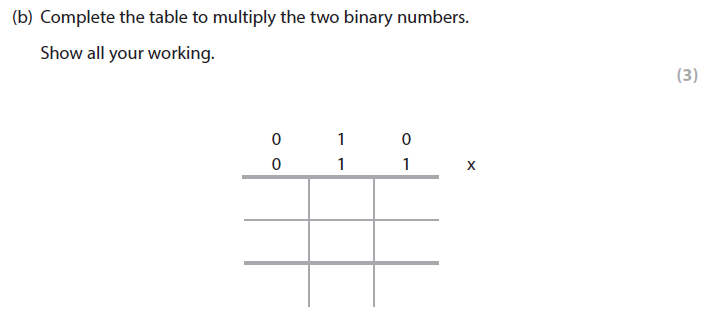
5b answer
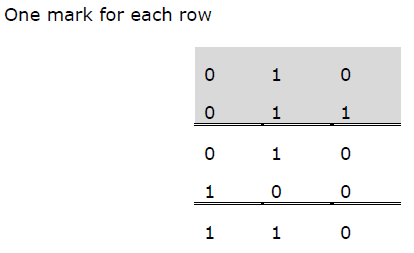
More help here -
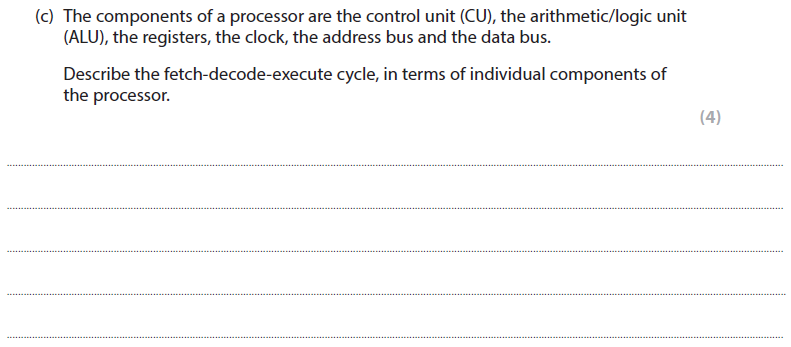
5c answer
Any 4 components with a correct description:
Control unit – coordinates the timing between the different components required to execute an instruction. In some instances, it is credited with doing the decode function.
Arithmetic logic unit (ALU) – Performs arithmetic (+, -, *, /) and logic operations (AND, OR, NOT) on data
Registers – Very fast (when compared with main memory RAM) memory that is used to hold the results of operations, data, or instructions. The instruction pointer is a register which holds the memory address of the next instruction to execute.
Clock – A signal that is generated by a crystal which controls the timing of the fetch-decode-execute cycle. In a simple computer, one instruction is fetched, decoded, and executed on each clock cycle.
Address bus – Holds the addresses of memory, input devices, or output devices needed for an instruction.
Data bus – Holds the data that is being transferred between components such as a hard disc and memory. Instructions can move from memory to the registers over this bus.
More help here -
Control unit – coordinates the timing between the different components required to execute an instruction. In some instances, it is credited with doing the decode function.
Arithmetic logic unit (ALU) – Performs arithmetic (+, -, *, /) and logic operations (AND, OR, NOT) on data
Registers – Very fast (when compared with main memory RAM) memory that is used to hold the results of operations, data, or instructions. The instruction pointer is a register which holds the memory address of the next instruction to execute.
Clock – A signal that is generated by a crystal which controls the timing of the fetch-decode-execute cycle. In a simple computer, one instruction is fetched, decoded, and executed on each clock cycle.
Address bus – Holds the addresses of memory, input devices, or output devices needed for an instruction.
Data bus – Holds the data that is being transferred between components such as a hard disc and memory. Instructions can move from memory to the registers over this bus.
More help here -
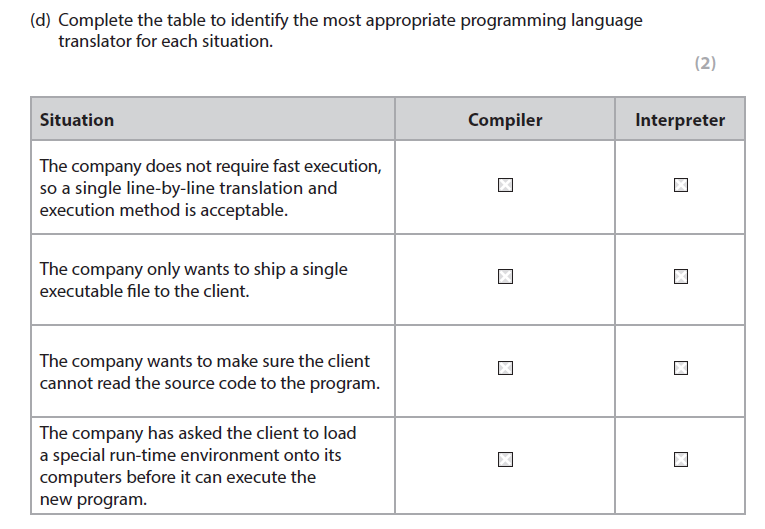
5d answer
More help here -
5e answer
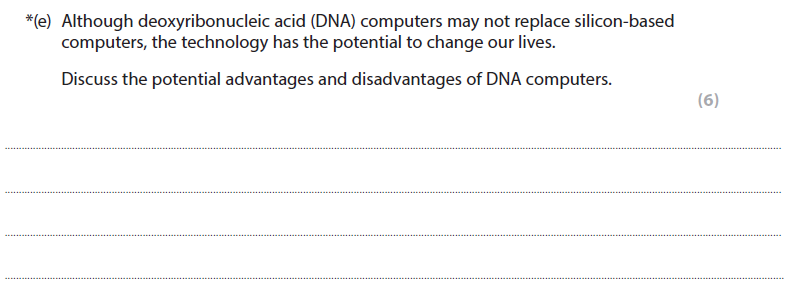
Indicative content:
Speed:
Cost:
Environment:
Reliability:
Applicability:
• Because DNA is so small, it will allow very small computing devices
• DNA computing is in its infancy, we will see improvements the same as we did with silicon based computers
Quality of Written Communication:
• 1-2: Some basic points from at least one of the categories; little clarification or expansion of points; spelling, grammar, and punctuation errors hinder meaning.
• 3-4: At least one relevant point from more than one category; some clarification or expansion of points; spelling, grammar, and punctuation errors occur, but do not hinder meaning.
• 5-6: Relevant points from more than one category; comprehensive clarification or expansion of points; spelling, grammar, and punctuation are used accurately and meaning is clear.
Example:
DNA computers might be used inside the human body to control how it responds to diseases. One day they might be designed to help the body fight diseases. (One category; little expansion; QWC ok; 2 marks max)
Example:
DNA is really cheap because there is so much of it. It’s living, so we can grow it. However, to make a DNA computer work is still very expensive, because it’s a new technology. One day, a DNA computer could be faster than the ones we have now. (Three categories; little expansion; QWC ok; 4 marks max)
Example:
DNA computers could change the world because we may use them inside
human bodies. They could be used to fight diseases. Right now it is expensive to make a DNA computer, but in the future it will get cheaper.
This is because there is so much DNA in the world that it is a cheap material. And, because it stores at a molecular level, we will be able to store a great deal of data. So, DNA, in the future, could really change our lives. (Four categories; some expansion; QWC ok; 6 marks max)
Example:
• DNA is cheap
• DNA computers could be used inside the human body
• DNA computers are slow
• DNA does not degrade
(Four categories; QWC no expansion; 2 marks max)
More help here -
Speed:
- Potentially slower than the computers we have now
- Tasks are performed in parallel, so some problems could be solved much quicker than conventional computers
Cost:
- Because it’s new and scarce, a DNA computer could be more expensive than the computers we have now
- Because there is so much of it and is easy to produce, DNA is cheaper than conventional media
- Storing at a molecular level provides much more data storage
Environment:
- There is a potential for using fewer toxic chemicals in creating DNA computers
- There is a potential for DNA computers to require little or no electrical power to run
- DNA manufacturing / growing is a quicker, cleaner process than manufacturing silicon chips
Reliability:
- DNA degrades very slowly
- Currently needs a good deal of human assistance to complete solutions
- Is time consuming to implement
Applicability:
- DNA computers may be made to work inside living organisms
• Because DNA is so small, it will allow very small computing devices
• DNA computing is in its infancy, we will see improvements the same as we did with silicon based computers
Quality of Written Communication:
• 1-2: Some basic points from at least one of the categories; little clarification or expansion of points; spelling, grammar, and punctuation errors hinder meaning.
• 3-4: At least one relevant point from more than one category; some clarification or expansion of points; spelling, grammar, and punctuation errors occur, but do not hinder meaning.
• 5-6: Relevant points from more than one category; comprehensive clarification or expansion of points; spelling, grammar, and punctuation are used accurately and meaning is clear.
Example:
DNA computers might be used inside the human body to control how it responds to diseases. One day they might be designed to help the body fight diseases. (One category; little expansion; QWC ok; 2 marks max)
Example:
DNA is really cheap because there is so much of it. It’s living, so we can grow it. However, to make a DNA computer work is still very expensive, because it’s a new technology. One day, a DNA computer could be faster than the ones we have now. (Three categories; little expansion; QWC ok; 4 marks max)
Example:
DNA computers could change the world because we may use them inside
human bodies. They could be used to fight diseases. Right now it is expensive to make a DNA computer, but in the future it will get cheaper.
This is because there is so much DNA in the world that it is a cheap material. And, because it stores at a molecular level, we will be able to store a great deal of data. So, DNA, in the future, could really change our lives. (Four categories; some expansion; QWC ok; 6 marks max)
Example:
• DNA is cheap
• DNA computers could be used inside the human body
• DNA computers are slow
• DNA does not degrade
(Four categories; QWC no expansion; 2 marks max)
More help here -