Computer science
  • Exam boards
    • OCR past papers >
      • Paper 1 J277 >
        • Paper1 (Sample) J277
        • Practice paper1 J277
      • Paper 2 J277 >
        • Paper 2 J277 Practice
    • Edexcel past papers >
      • 2020 Current spec (coming soon) >
        • Programming Language Subset (PLS)
      • Old 2016 SPEC >
        • Paper 1 (specimen1)
        • Paper 1 (specimen2)
        • Paper 1 (2018)
        • Paper 1 (2019)
        • Paper 2 (specimen1)
        • Paper 2 (2018)
        • Paper 2 (2019)
      • OLD 2013 SPEC >
        • Sample assessment 1 (old spec)
        • Sample assessment 2 (old spec)
        • June 2017 (old spec)
        • June 2016 (old spec)
        • June 2015 (old spec)
    • Paper 1 (by topic) >
      • Algorithms
      • Application software
      • Ascii
      • Binary
      • Cache
      • Client Server
      • Cloud
      • Compression
      • Computational thinking
      • CPU
      • Cyber security
      • Database
      • Fetch decode execute cycle
      • Embedded system
      • Encryption
      • File size
      • Flow chart
      • Hexadecimal
      • High Level language
      • ISP/Internet
      • Logic
      • Magnetic HDD
      • Networking
      • Open source
      • Operating system
      • Peer to peer
      • Images (Data representation)
      • Protocols
      • RAM
      • ROM
      • Run length encoding
      • Simulation software
      • Solid state HDD
      • Sound
      • Stored program concept
      • Utility software
    • Curriculum >
      • Binary
      • Hex
      • Data Representation
      • Compression
      • Encryption
      • What is a computer
      • How does a computer work
      • Hardware
      • Operating system
      • The CPU
      • Input devices
      • Data storage
      • Networks
      • Microcontrollers
      • Computational models
      • Emerging trends
      • Virtual machine
      • Models and simulators
      • Algorithms
    • Python >
      • Finding python
      • GCSE Python questions
      • Python coding >
        • Comments
        • Data types
        • Variables
        • If Else (Selection)
        • If Elif Else (Selection) >
          • Relational/Comparison Operator challenges
          • Selection challenges
        • Functions
        • For loop (iteration)
        • While loop (iteration) >
          • While loop challenges
        • Data structures >
          • Array challenges
          • 2D Array challenges
          • Looping thru 2D array
        • String slicing/indexing >
          • String slicing challenges
        • Subprograms >
          • Subprogram challenges
        • Local/global variable
        • Validation and try
        • methods
        • File I/O >
          • Files - Challenges
        • Pseudocode
        • Modules >
          • Turtle
        • Classes
        • NEA/Projects
  • KS3/Other
    • KS3 >
      • Coding >
        • GameMaker
        • HTML >
          • HTML tags
        • Scratch >
          • Scratch questions
        • Python >
          • Getting started
          • Functions
          • Variables
          • VariablesToo
          • inputs
          • Selection
          • Flowcharts
          • Data types
          • Pseudocode1
          • Pseudocode2
          • Subprogram1
          • Subprogram2
          • Coding challenges
      • Online Safety >
        • Screen time
        • Online Safety questions
      • IT >
        • Word
        • PowerPoint
      • Hardware >
        • All Hardware
        • Magnetic hard disk drive
        • Optical disk drive
        • Solid state drive
      • Logic >
        • CPU
        • AND gate
        • OR gate
        • NOT gate
        • Logical statements
      • Software
      • Binary/Hex/Algorithms >
        • Binary
        • Binary explained
        • Hexadecimal - 1 digit
        • Hexadecimal - 2 digits
        • Algorithms
        • ASCII
      • Networks
      • Protocols/Cyber attacks
    • BTEC CS
    • OCR A-Level >
      • 1.2 (Unit 2) >
        • Functions of an OS
        • Types of OS
        • Application generation
      • 1.2 (Unit 3) >
        • Software development
        • Algorithms
        • Programming paradigms
      • 1.3 (Unit 5) >
        • Networks
      • 1.5 (Unit 9) >
        • Laws and Acts
      • 2.3 (Unit 12) >
        • Analysis and design of algorithms
    • AQA AS-Level CS >
      • AS Curriculum >
        • Multiple choice questions
    • Business studies >
      • Keywords
      • BS Revision - Multiple choice
      • Paper 1 (9-1)
      • Paper 2 (9-1)
    • Junior Science >
      • 01 - Particles >
        • investigations and data
        • Equipment
        • Particles
      • 02 - Cells >
        • Microscope introduced
        • Looking at cells
        • Specialised cells
        • Unicellular organisms
      • 03 - Energy >
        • Energy introduced
        • Energy transfers
        • Conduction, Convection, Insulators
      • 04 - Chemical ideas & reactions >
        • Periodic table
        • Chemical reactions
        • Chemical reactions2
      • 05 - Light and Sound >
        • Light introduced
        • The Eye
        • Colours and filters
        • Waves and Sound
  • Contact/More
    • Code editor
    • Contact us
    • Microbit ideas
    • More
  • Self test
    • 01 Random topics
    • 02 Programming
    • 03 Data
    • 04 Computers
    • 05 Networks
    • 06 Legal/Ethics/Enviro'
    • Coding/Programming

Python coding

PYTHON DICTIONARY


Comments

Data types

Variables

If Else

If Elif Else

Functions

For loop

While loop

Data structures

String slicing

User defined function

Local/Global variable

Validation and Try

Methods

​File I/O

Pseudocode

Classes

Modules

Modules

​What is a class? Simply put, a class is an easy way to group similar variables and (user defined) functions together and then apply them to something called an “object”.
Picture

In the example below, our object will be a football team and the variables and functions will enable a team to score a goal or a penalty. (Before learning what a class is, you will first need an appreciation of user defined functions and variables.)

One object (e.g. football team) will be an instance of our class and have access to all the attributes within that class.

A second object (e.g. a different football team) will be a separate instance of a our class and have access to all the same attributes within that class as our first football team did.
​
Although both teams use the attributes in the class (e.g. score goals or score penalties) we like Python because holds each of the football team’s data entirely separately.


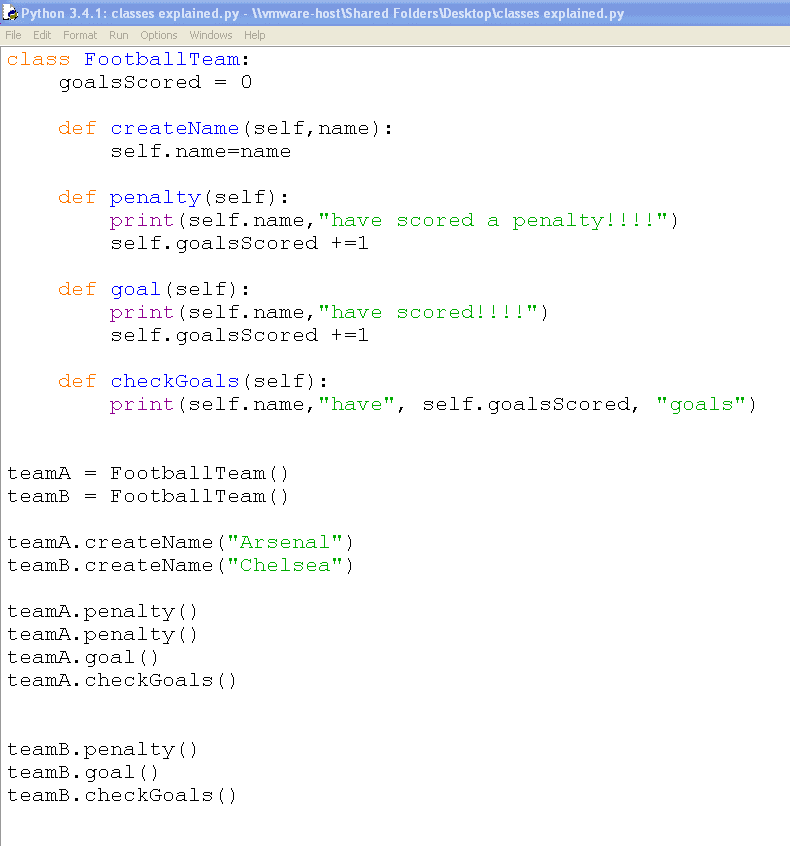
 - Here is a full example of a "class" called "FootballTeam" - See below for a breakdown
Picture

Picture
Home
Contact
  • Exam boards
    • OCR past papers >
      • Paper 1 J277 >
        • Paper1 (Sample) J277
        • Practice paper1 J277
      • Paper 2 J277 >
        • Paper 2 J277 Practice
    • Edexcel past papers >
      • 2020 Current spec (coming soon) >
        • Programming Language Subset (PLS)
      • Old 2016 SPEC >
        • Paper 1 (specimen1)
        • Paper 1 (specimen2)
        • Paper 1 (2018)
        • Paper 1 (2019)
        • Paper 2 (specimen1)
        • Paper 2 (2018)
        • Paper 2 (2019)
      • OLD 2013 SPEC >
        • Sample assessment 1 (old spec)
        • Sample assessment 2 (old spec)
        • June 2017 (old spec)
        • June 2016 (old spec)
        • June 2015 (old spec)
    • Paper 1 (by topic) >
      • Algorithms
      • Application software
      • Ascii
      • Binary
      • Cache
      • Client Server
      • Cloud
      • Compression
      • Computational thinking
      • CPU
      • Cyber security
      • Database
      • Fetch decode execute cycle
      • Embedded system
      • Encryption
      • File size
      • Flow chart
      • Hexadecimal
      • High Level language
      • ISP/Internet
      • Logic
      • Magnetic HDD
      • Networking
      • Open source
      • Operating system
      • Peer to peer
      • Images (Data representation)
      • Protocols
      • RAM
      • ROM
      • Run length encoding
      • Simulation software
      • Solid state HDD
      • Sound
      • Stored program concept
      • Utility software
    • Curriculum >
      • Binary
      • Hex
      • Data Representation
      • Compression
      • Encryption
      • What is a computer
      • How does a computer work
      • Hardware
      • Operating system
      • The CPU
      • Input devices
      • Data storage
      • Networks
      • Microcontrollers
      • Computational models
      • Emerging trends
      • Virtual machine
      • Models and simulators
      • Algorithms
    • Python >
      • Finding python
      • GCSE Python questions
      • Python coding >
        • Comments
        • Data types
        • Variables
        • If Else (Selection)
        • If Elif Else (Selection) >
          • Relational/Comparison Operator challenges
          • Selection challenges
        • Functions
        • For loop (iteration)
        • While loop (iteration) >
          • While loop challenges
        • Data structures >
          • Array challenges
          • 2D Array challenges
          • Looping thru 2D array
        • String slicing/indexing >
          • String slicing challenges
        • Subprograms >
          • Subprogram challenges
        • Local/global variable
        • Validation and try
        • methods
        • File I/O >
          • Files - Challenges
        • Pseudocode
        • Modules >
          • Turtle
        • Classes
        • NEA/Projects
  • KS3/Other
    • KS3 >
      • Coding >
        • GameMaker
        • HTML >
          • HTML tags
        • Scratch >
          • Scratch questions
        • Python >
          • Getting started
          • Functions
          • Variables
          • VariablesToo
          • inputs
          • Selection
          • Flowcharts
          • Data types
          • Pseudocode1
          • Pseudocode2
          • Subprogram1
          • Subprogram2
          • Coding challenges
      • Online Safety >
        • Screen time
        • Online Safety questions
      • IT >
        • Word
        • PowerPoint
      • Hardware >
        • All Hardware
        • Magnetic hard disk drive
        • Optical disk drive
        • Solid state drive
      • Logic >
        • CPU
        • AND gate
        • OR gate
        • NOT gate
        • Logical statements
      • Software
      • Binary/Hex/Algorithms >
        • Binary
        • Binary explained
        • Hexadecimal - 1 digit
        • Hexadecimal - 2 digits
        • Algorithms
        • ASCII
      • Networks
      • Protocols/Cyber attacks
    • BTEC CS
    • OCR A-Level >
      • 1.2 (Unit 2) >
        • Functions of an OS
        • Types of OS
        • Application generation
      • 1.2 (Unit 3) >
        • Software development
        • Algorithms
        • Programming paradigms
      • 1.3 (Unit 5) >
        • Networks
      • 1.5 (Unit 9) >
        • Laws and Acts
      • 2.3 (Unit 12) >
        • Analysis and design of algorithms
    • AQA AS-Level CS >
      • AS Curriculum >
        • Multiple choice questions
    • Business studies >
      • Keywords
      • BS Revision - Multiple choice
      • Paper 1 (9-1)
      • Paper 2 (9-1)
    • Junior Science >
      • 01 - Particles >
        • investigations and data
        • Equipment
        • Particles
      • 02 - Cells >
        • Microscope introduced
        • Looking at cells
        • Specialised cells
        • Unicellular organisms
      • 03 - Energy >
        • Energy introduced
        • Energy transfers
        • Conduction, Convection, Insulators
      • 04 - Chemical ideas & reactions >
        • Periodic table
        • Chemical reactions
        • Chemical reactions2
      • 05 - Light and Sound >
        • Light introduced
        • The Eye
        • Colours and filters
        • Waves and Sound
  • Contact/More
    • Code editor
    • Contact us
    • Microbit ideas
    • More
  • Self test
    • 01 Random topics
    • 02 Programming
    • 03 Data
    • 04 Computers
    • 05 Networks
    • 06 Legal/Ethics/Enviro'
    • Coding/Programming